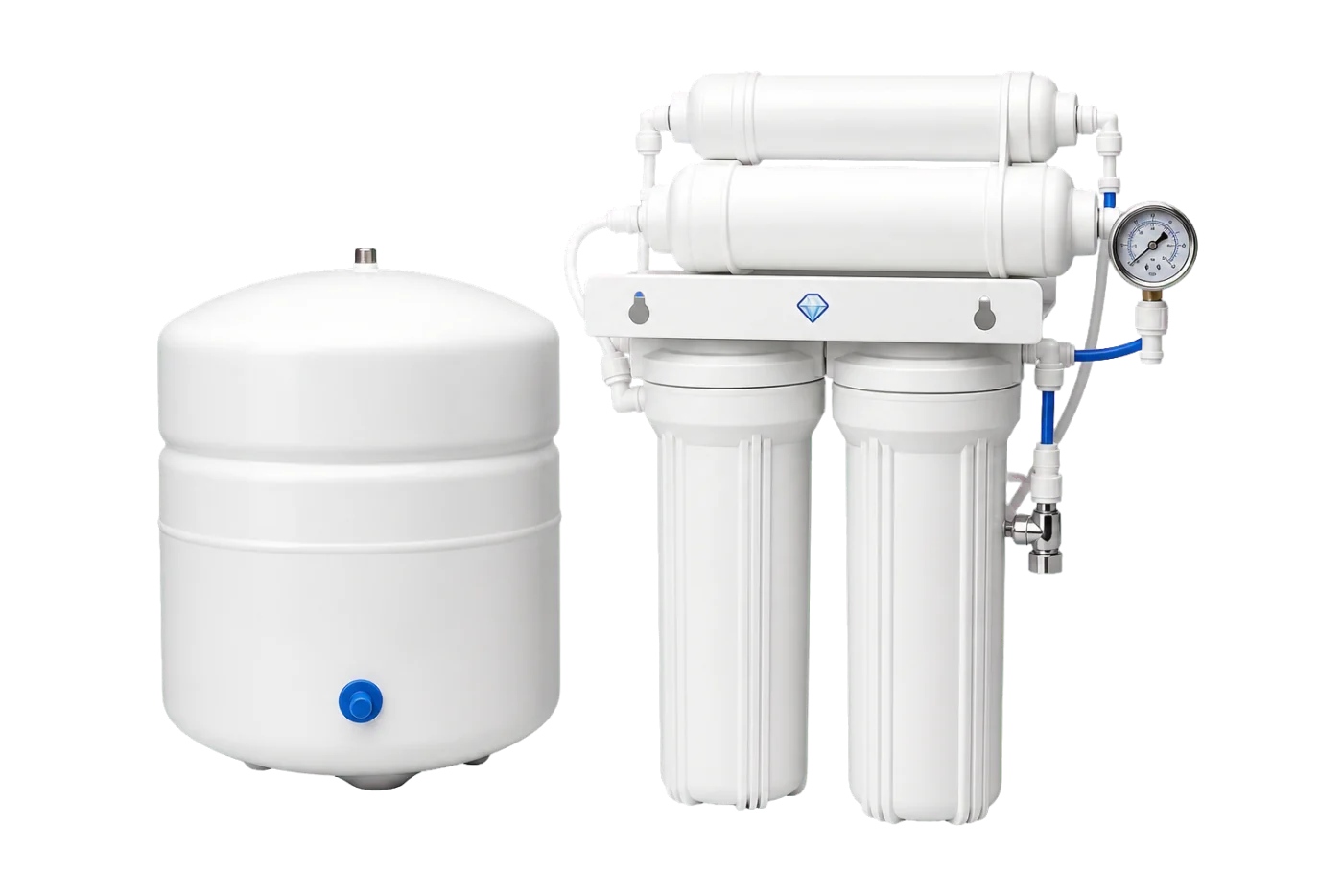
THE REAL QUESTIONWhere the water is treated, not how good the system is
Point of use means the equipment sits at one outlet and treats only what passes through it. Point of entry means it sits where the supply arrives and treats everything downstream. That difference decides almost everything else: physical size, how much water passes through it each day, how thoroughly it can treat that water, and what it costs to keep running. Comparing a reverse osmosis unit with a whole-house system as though they were competing products obscures the question that actually matters, which is which taps you want changed.
- Point of use: one outlet, small volume, thorough treatment
- Point of entry: every outlet, large volume, broader treatment
- Decide which outlets matter before comparing equipment
HOW RO WORKSWhat reverse osmosis is doing
A reverse osmosis system pushes water under household pressure against a semi-permeable membrane. Water passes through; a substantial share of what was dissolved in it does not, and is carried away to the drain. Pre-filters protect the membrane from sediment and chlorine, which would shorten its life, and a post-filter polishes what comes out. Treated water is usually held in a small tank so a glass can be drawn immediately rather than at the rate the membrane produces it. This is the most thorough treatment commonly available in a home, and the reason it is restricted to one tap is that it is slow and discards water to achieve that.
- A membrane separates water from much of what is dissolved in it
- Pre-filters protect the membrane; a post-filter polishes the output
- A storage tank covers the gap between demand and production rate
HOW POE WORKSWhat whole house filtration is doing
A whole-house system is fitted at the point of entry and treats everything the property draws. It is normally a sequence: sediment removal first, then media chosen for what the water carries, commonly carbon where chlorine, taste or odor are the concern. It has to handle the whole household's flow, so it is sized for throughput rather than for the most thorough possible treatment of a glass of water. What it changes is every outlet: showers, laundry, the kitchen tap, the outside tap.
- One system at the entry point, serving the whole property
- Staged, with coarse protection ahead of finer media
- Sized for household flow rather than maximum thoroughness
SIDE BY SIDEReverse osmosis and whole house filtration compared
Set out together, the two stop looking like competitors. Each row describes a consequence of where the equipment sits rather than a judgement about quality.
Point-of-use reverse osmosis compared with point-of-entry filtration| Comparison | Reverse osmosis | Whole house filtration |
|---|
| Outlets treated | One, normally a dedicated kitchen tap. | Every outlet in the property. |
|---|
| Treatment standard | The most thorough commonly available in a home. | Broad treatment of what the water carries, per the media. |
|---|
| Daily volume | Drinking and cooking only. | Everything the household uses. |
|---|
| Sends water to drain | Yes, as part of how the membrane works. | No, beyond any periodic backwash the system performs. |
|---|
| Where it is installed | Under a sink, with its own tap and a small tank. | At the supply entry, which needs space and access. |
|---|
| Affects showers and laundry | No. | Yes. |
|---|
| Ongoing attention | Pre- and post-filters periodically; the membrane less often. | Media replaced on a schedule set per installation. |
|---|
When reverse osmosis alone is the right answer
If the concern is specifically what you drink and cook with, and the water elsewhere in the house is not a problem, a point-of-use system is the proportionate answer. It is smaller, it does not involve work at the supply entry, and it concentrates the treatment where you want it. Households who filter drinking water with jugs or buy bottled water are often describing exactly this situation: the complaint is confined to the kitchen.
- The complaint is confined to drinking and cooking
- No work needed at the supply entry
- Replaces jug filters and bottled water
CHOOSING POEWhen whole house filtration alone is the right answer
If the complaint follows you around the house, a point-of-use system cannot solve it. A chlorine smell noticeable in the shower, sediment reaching every tap, water that looks cloudy wherever it is drawn: these are properties of the supply, and they have to be addressed where the supply arrives. Plenty of households find that once the whole property is treated, the kitchen tap is acceptable without anything further.
- The complaint appears at more than one outlet
- Showers, laundry and outside taps are included
- Often enough on its own
BOTH TOGETHERWhy the two are often installed together
The combination is common because the two treat different problems well. Whole-house filtration raises the standard everywhere and, in doing so, removes chlorine and sediment that would otherwise shorten the life of a membrane downstream. The reverse osmosis stage then takes the kitchen tap considerably further. Installed in that order, each one is doing work the other cannot, and the point-of-entry system is also protecting the more expensive consumable.
- Point-of-entry treatment raises the standard everywhere
- It also protects the membrane from chlorine and sediment
- The point-of-use stage then goes further at one tap
PRACTICALITIESSpace, drainage and the plumbing each one needs
Reverse osmosis needs room under the sink for the unit and its tank, a drain connection for what the membrane rejects, and a hole in the worktop or sink for its own tap. Whole-house filtration needs space at the supply entry, access for servicing, and in some configurations drainage as well. Neither is exotic, but both are decided by what the property allows, which is why a specification made without anyone looking at the house is guesswork.
- RO: under-sink space, a drain connection, a dedicated tap
- POE: space and service access at the supply entry
- The property, not the catalogue, narrows the choice
OWNERSHIPWhat each one asks of you over time
Both have consumables, on different cycles. A reverse osmosis system has pre- and post-filters changed relatively often and a membrane that lasts considerably longer, with the interval depending on the equipment and the water put through it. Whole-house media is replaced on a schedule that depends on the configuration and household demand. The honest version of this conversation gives you intervals for the specific equipment proposed, not a general figure, and a system whose upkeep you will not keep up with is the wrong system.
- RO: filters changed often, membrane far less often
- POE: media replaced per configuration and demand
- Ask for intervals for the actual equipment proposed
SUPPLY TYPEMunicipal supply or a private well changes the starting point
A property on a municipal supply receives water that has already been treated and disinfected, so the questions are usually about what remains and what the disinfectant does to taste. A private well is untreated, and what is appropriate depends on what testing shows. In both cases the specification follows from what the supply actually is, and on a well that means testing rather than a recommendation made on the doorstep.
- Municipal: already treated; questions about residue and taste
- Well: untreated; testing comes before any specification
- Supply type should be established before equipment is discussed
CHECKLISTHow to decide between them
Work through four questions in order. Which outlets does the complaint affect? Is it taste, smell, appearance or deposit? Is the supply municipal or a private well? And what does the property physically allow at the sink and at the entry point? Those four answers usually point at one configuration without much ambiguity, which is the purpose of an assessment.
- Which outlets does the complaint affect?
- Is it taste, smell, appearance or deposit?
- Municipal supply or private well?
- What does the property allow at each location?
If the complaint turns out to be deposit on fixtures rather than taste at the tap, neither of these is the technology you need, and the softener comparison is the better place to start.
Water softener vs whole house filter →Comparing all three approaches →What whole house filtration costs →Schedule a Free Assessment →
FAQDoes reverse osmosis filter the water for my whole house?
No. It is point-of-use equipment serving one tap, normally in the kitchen. Showers, laundry and the other taps are unaffected. Treating every outlet requires a system at the point of entry.
FAQCan I put reverse osmosis on the whole house instead?
It is not how reverse osmosis is normally applied in a home. The process is slow relative to household demand and sends water to drain, so applying it to all the water a house uses is a poor fit. Point-of-entry filtration is the appropriate technology for whole-property treatment.
FAQIf I have whole house filtration, do I still need reverse osmosis?
Not necessarily. Many households find the kitchen tap acceptable once the property is treated. Reverse osmosis is worth adding when you want a higher standard specifically for drinking and cooking than a point-of-entry system is designed to deliver.
FAQWhich should be installed first if I want both?
Whole-house filtration generally goes in first, because it removes chlorine and sediment that would otherwise shorten the life of the membrane downstream. If both are planned together, that sequencing should be part of the specification rather than decided on installation day.
FAQWill either of them soften my water?
Neither is a softener. Softening addresses dissolved hardness minerals through ion exchange, and that is a separate technology. If deposit on fixtures or inside your water heater is the complaint, a softener is what addresses it.